During the last week of July, I had the opportunity to participate in a food drive with Governor Rell at the Fire Station on Phoenix Ave. The food drive was really a kick off to a July 31st event, the statewide “Day of Caring & Compassion”. On that day, several fire stations around Connecticut served as collection centers for donations of non-perishable food to help replenish the state’s two main food pantries- Foodshare and the Connecticut Food Bank.
I have not yet heard how much food was collected that day, but I have no doubt that the great folks in Enfield and our state came out to do what they could to feed those in need.
Just last week, one of the headlines in a major Connecticut paper stated that our food pantries were running out of food. While there have been some indicators that our economy is recovering, the truth is, we still have far too many people out of work and in need of food and housing.
Usually, food banks around our state kick off food drives over the holidays, when people are feeling especially generous. But this year is not a typical year and it is important now more than ever that we lend a helping hand to those around us. Especially during these summer months, families are struggling to put food on the table. Many children receive free breakfast and lunch at school, and when they are home for the summer, their parents suddenly have to provide for close to ten extra meals a week, per child.
One statistic from the Connecticut Food Bank website that stuck out to me was that 55% of those served by food banks are from small towns or suburban areas. I know many people tend to think of poverty and hunger is a city problem, but the truth is many people are suffering as unemployment remains at its highest level in decades.
Here in Enfield, the Food Shelf and Loaves and Fishes do what they can to feed the hungry. As are all soup kitchens and food pantries, they are only able to serve those in need because of the generosity of others. Many people volunteer not only food, but also time. If you are interested in donating to either of these organizations, please contact my office and we will be happy to provide you the information you need. Right now, Enfield Loaves and Fishes is looking for garden vegetables. If you are experiencing an especially good harvest in your garden this year, as many folks are, I hope you will consider donating some extras to those in need.
Tuesday, August 10, 2010

Wednesday, July 28, 2010
Learn How To Become An Adoptive Or Foster Parent Through The State Of Connecticut
Many of you know that Marcy and I are the proud parents of two children, Aidan and Deana, who we adopted from South Korea. They are the lights of our lives, and raising them is the most important, joyful, thing we will ever do.
Not surprisingly, Marcy and I spend a lot of time and energy sharing our story with others who are considering the possibility of creating or expanding their families through adoption. We always tell them that the first step on this journey is to gather all the information they can find. For those who are considering adopting or becoming a foster parent through the state of Connecticut, that task is becoming easier.
Recently, the state Department of Children and Families (DCF) launched a new website to provide information for those who are already foster and adoptive parents, and to recruit new families to care for children who need homes. Now, prospective foster and adoptive parents can find much of the initial information they need in one place at www.ctfosteradopt.com. Visitors to this website can even fill out an online form to request information and make comments and suggestions. Of course, those seeking information may still call the state Department of Children and Families at 1-888-KID-HERO (1-888-543-4376).
Among other things, the website features the Heart Gallery, a display of children and youth who are seeking homes and have agreed to be photographed. These pictures, taken by volunteer professional photographers, become part of a traveling exhibit that is displayed at theaters, museums, galleries, hospitals, malls, town halls and libraries across the state. It is the work of public and private partnerships, including the Connecticut Association of Foster and Adoptive Parents. Visitors to the Heart Gallery page on the new website can click on each photo to learn about each featured child how to obtain additional information from a contact in the DCF Office of Foster Care and Adoption Services.
The website also includes information about financial and other types of services available; policies and regulations; legal issues; support groups; and licensing and training. Furthermore, this website explains the Connecticut Search Law, which provides birth parents, birth relatives, adult adoptees, adults formerly in foster care, and adoptive parents with access to certain information contained in adoption files. The laws regarding adoption files are very specific, and this page includes a “frequently asked questions” section. One question answered in this section states that the Office of Foster Care and Adoption Services in DCF has a master database of all public and private adoptions that have occurred in Connecticut since 1944. For more information, call 860-550-6582.
I urge everyone considering becoming a foster or adoptive parent to consider pursuing this dream through the state Department of Children and Families. As I have said before, Marcy and I know firsthand that hearts do not know the difference between becoming a parent through birth or adoption.
I always welcome the opportunity to talk about the joys of becoming a parent through adoption. I can be reached at my legislative office in Hartford at 1-800-842-1421, or via e-mail to Rob.Kane@cga.ct.gov.
Not surprisingly, Marcy and I spend a lot of time and energy sharing our story with others who are considering the possibility of creating or expanding their families through adoption. We always tell them that the first step on this journey is to gather all the information they can find. For those who are considering adopting or becoming a foster parent through the state of Connecticut, that task is becoming easier.
Recently, the state Department of Children and Families (DCF) launched a new website to provide information for those who are already foster and adoptive parents, and to recruit new families to care for children who need homes. Now, prospective foster and adoptive parents can find much of the initial information they need in one place at www.ctfosteradopt.com. Visitors to this website can even fill out an online form to request information and make comments and suggestions. Of course, those seeking information may still call the state Department of Children and Families at 1-888-KID-HERO (1-888-543-4376).
Among other things, the website features the Heart Gallery, a display of children and youth who are seeking homes and have agreed to be photographed. These pictures, taken by volunteer professional photographers, become part of a traveling exhibit that is displayed at theaters, museums, galleries, hospitals, malls, town halls and libraries across the state. It is the work of public and private partnerships, including the Connecticut Association of Foster and Adoptive Parents. Visitors to the Heart Gallery page on the new website can click on each photo to learn about each featured child how to obtain additional information from a contact in the DCF Office of Foster Care and Adoption Services.
The website also includes information about financial and other types of services available; policies and regulations; legal issues; support groups; and licensing and training. Furthermore, this website explains the Connecticut Search Law, which provides birth parents, birth relatives, adult adoptees, adults formerly in foster care, and adoptive parents with access to certain information contained in adoption files. The laws regarding adoption files are very specific, and this page includes a “frequently asked questions” section. One question answered in this section states that the Office of Foster Care and Adoption Services in DCF has a master database of all public and private adoptions that have occurred in Connecticut since 1944. For more information, call 860-550-6582.
I urge everyone considering becoming a foster or adoptive parent to consider pursuing this dream through the state Department of Children and Families. As I have said before, Marcy and I know firsthand that hearts do not know the difference between becoming a parent through birth or adoption.
I always welcome the opportunity to talk about the joys of becoming a parent through adoption. I can be reached at my legislative office in Hartford at 1-800-842-1421, or via e-mail to Rob.Kane@cga.ct.gov.
Wednesday, June 23, 2010
The Folly Of "Kicking The Can Down The Road" As A State Budget Strategy
When confronted with the staggering problems affecting Connecticut's economy, I am incredulous. As our economy struggles, state officials seem even more determined to continue on the destructive path that brought us to this point.
The state budget that takes effect on July 1st relies on habitual shortcuts of borrowing and increasing taxes to avoid making necessary spending cuts. This places a burden on Connecticut's businesses and families. Rather than confronting our financial problems, they merely delay the hard choices we must make.
The gross mismanagement of our state's finances cannot be ignored. The recent, predictable, downgrading of state bonds by one of the nation's top rating agencies affirms our financial predicament. As Connecticut prepares to borrow money to cover its budget deficit again, Fitch analysts note, “the state relies on borrowing to address its ongoing fiscal challenges in the context of already high liabilities and large projected structural gaps." Analysts for Moody's reported, “Connecticut has the highest net tax-supported debt among the 50 states." Furthermore, “Connecticut is more dependent than most states on high-income earners." Our per capita tax rate is 64% higher than the national average. Interestingly, Maine and Rhode Island have moved to reduce taxes for high earning residents. Legislative leaders in Rhode Island are correct when they state, “lowering the marginal tax rate (to 5.9% versus Connecticut's 6.5%) will help make Rhode Island more appealing to companies looking to come into the state". Meanwhile, Connecticut continues to discourage its most productive residents by laying the cost of financial profligacy at their feet.
Consequently, our business climate has soured. CEO Magazine stated that businesses view the northeast as “very expensive, with some of the highest wages, taxes, regulations and cost of facilities in the nation." Sadly, Connecticut has offered no challenge to this perception. In fact, within just the last five years we have fallen to 45th place as a state most conducive to business. Connecticut must halt this decline to regain its former status as the best state in which to live, work, raise a family and retire.
Enormous challenges remain. Connecticut faces deficits of more than $3 billion in 2012 and 2013. Union leaders while controlling the Connecticut House of Representatives continue to push through higher salaries and benefits. Connecticut also faces $43 billion in unfunded pension and retirement liabilities. Instead of cutting back on wage increases, state union leaders successfully fought to underfund state pensions by $100 million this budget cycle. Some conclude that state government borrowing makes tax hikes inevitable. Not true; it is this type of thinking that has fed Connecticut's insatiable appetite for spending and has made us the state with the highest tax burden in the country. Increasing taxes is not the answer; fiscal austerity is.
Reinventing state government will take political courage. As noted by Institutional Investor, March 2010, “The bad news is that solutions require steely will on the part of politicians faced with determined and organized public employee unions. Such courage is a rarity in the world of realpolitik". Until now, Connecticut's politicians have kicked the proverbial can down the road. Their lack of courage has led to a public outcry for fiscal responsibility that has gone unanswered.
State budget problems we now face are monumental. We cannot continue to pretend the situation will improve without a dramatic change in direction. Connecticut's taxpayers are now demanding more than fiscal responsibility – they are demanding accountability.
The state budget that takes effect on July 1st relies on habitual shortcuts of borrowing and increasing taxes to avoid making necessary spending cuts. This places a burden on Connecticut's businesses and families. Rather than confronting our financial problems, they merely delay the hard choices we must make.
The gross mismanagement of our state's finances cannot be ignored. The recent, predictable, downgrading of state bonds by one of the nation's top rating agencies affirms our financial predicament. As Connecticut prepares to borrow money to cover its budget deficit again, Fitch analysts note, “the state relies on borrowing to address its ongoing fiscal challenges in the context of already high liabilities and large projected structural gaps." Analysts for Moody's reported, “Connecticut has the highest net tax-supported debt among the 50 states." Furthermore, “Connecticut is more dependent than most states on high-income earners." Our per capita tax rate is 64% higher than the national average. Interestingly, Maine and Rhode Island have moved to reduce taxes for high earning residents. Legislative leaders in Rhode Island are correct when they state, “lowering the marginal tax rate (to 5.9% versus Connecticut's 6.5%) will help make Rhode Island more appealing to companies looking to come into the state". Meanwhile, Connecticut continues to discourage its most productive residents by laying the cost of financial profligacy at their feet.
Consequently, our business climate has soured. CEO Magazine stated that businesses view the northeast as “very expensive, with some of the highest wages, taxes, regulations and cost of facilities in the nation." Sadly, Connecticut has offered no challenge to this perception. In fact, within just the last five years we have fallen to 45th place as a state most conducive to business. Connecticut must halt this decline to regain its former status as the best state in which to live, work, raise a family and retire.
Enormous challenges remain. Connecticut faces deficits of more than $3 billion in 2012 and 2013. Union leaders while controlling the Connecticut House of Representatives continue to push through higher salaries and benefits. Connecticut also faces $43 billion in unfunded pension and retirement liabilities. Instead of cutting back on wage increases, state union leaders successfully fought to underfund state pensions by $100 million this budget cycle. Some conclude that state government borrowing makes tax hikes inevitable. Not true; it is this type of thinking that has fed Connecticut's insatiable appetite for spending and has made us the state with the highest tax burden in the country. Increasing taxes is not the answer; fiscal austerity is.
Reinventing state government will take political courage. As noted by Institutional Investor, March 2010, “The bad news is that solutions require steely will on the part of politicians faced with determined and organized public employee unions. Such courage is a rarity in the world of realpolitik". Until now, Connecticut's politicians have kicked the proverbial can down the road. Their lack of courage has led to a public outcry for fiscal responsibility that has gone unanswered.
State budget problems we now face are monumental. We cannot continue to pretend the situation will improve without a dramatic change in direction. Connecticut's taxpayers are now demanding more than fiscal responsibility – they are demanding accountability.
Thursday, April 1, 2010
Connecticut’s Great Budget Saga Continues: Mounting Deficits Through 2014
Joe McGee of the Business Council of FairfieldCounty recently stated, "What the recession has done is unmask a structural imbalance in Connecticut’s fiscal policies that has been building for years." It has been clear to employers, taxpayers and a few elected officials for some time that our state has been heading for financial ruin due to the inaction by the General Assembly to confront reality. Our current budget deficit per person is nearly twice that of any other state, $1,700.00 (Nonprofit Quarterly, February 2010.) And, deficits continue to mount: $518 million by June 30, 2010, nearly $1 billion in 2011 and $4 billion in 2012, 2013 and 2014.
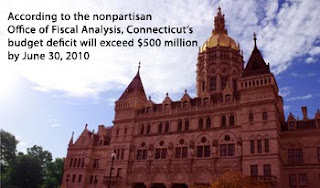

For a time, the legislative majority leadership’s reluctance to confront reality could have been attributed to their belief that the financial crisis was just a momentary blip from which we would quickly recover. Today, there is no excuse for their denial. We must stop spending money we do not have because our beleaguered taxpayers and the bedrock of our state, our remaining employers, cannot afford it. Connecticut already carries the heaviest per capita tax burden of $5,464.00 (Forbes, March 12, 2010) in the contiguous United States, along with the heaviest per capita state debt of $4,490.00 (Forbes, January 20, 2010.)
What has become apparent is a desire on the part of some in the legislature’s majority to protect state unions at the expense of private sector jobs. Their agenda calls for further increasing taxes on businesses, individual citizens and private sector bonuses. Yet longevity payments, which are state employee bonuses based on years worked rather than productivity, have been a longstanding practice. No wonder our state’s business climate is seen as unfriendly, to the extent that management for United Technologies recently voiced a desire to go "any place but Connecticut."
Recent events at the State Capitol highlight the need to make the difficult, responsible decisions necessary to end this fiscal crisis – regardless of how politically unpopular some of those decisions are. The latest chapter in the state budget impasse saga occurred last weekend when the Senate majority pushed through a so-called deficit mitigation plan calling for raising taxes by $180 million, but cutting spending by only $65 million. Keep in mind that the Senate passed this plan 21-15 shortly before 5:30 a.m. on Saturday after defeating plans offered by Governor Rell and the Senate Republicans, both of whom called for deeper spending cuts. Later in the day, the House decided against meeting in session to take up the Senate majority’s deficit mitigation plan. Why? It became clear that the House would not be able to marshal enough votes to override Governor Rell’s promise to veto the Senate majority’s woefully inadequate deficit mitigation plan.
Remember that there are enough members of the majority in both the Senate and the House to override any gubernatorial veto and pass a budget of their own.
So, where do we stand? So far, the only proposals taken seriously by the General Assembly’s majority leadership call for tax increases, instead of significant spending cuts. If we cannot work together to address the state’s existing $500 million deficit, how can we hope to pass a responsible, balanced budget for next year and head off the $11.4 billion deficit projected over the next three years? Democrats and Republicans must come together to resolve Connecticut’s ongoing, dangerous, fiscal crisis. At least half of the details included in our various plans are the same. Let’s agree to meet on common ground, and build from there.
Our state has lost 101,000 jobs between January of last year and January of this year. Unemployment is at 9.1 percent; the last time it was this high was 1976. State government is the largest employer in Connecticut, and our state workers are among the highest paid government employees in the nation. It should be noted that for every one dollar in private pay and benefits a private employee earned, a state or local government worker received one dollar and forty-five cents and that salaries were 30% and benefits 70% higher than private workers were. (Wall Street Journal, March 26, 2010.)
The bottom line is that Connecticut citizens are calling for immediate responsible action, but too many legislators are not listening. So let me repeat what you have been writing to me. You are saying you want an end to tax increases. You want the state to cut spending! You want the legislature to pass a deficit mitigation plan and a new state budget that does not further burden taxpayers and cost Connecticut more private sector jobs.
It is my fervent hope to report soon that Hartford has heard you, that common sense has returned to Connecticut and that taxpayers can look forward to better times ahead.
What has become apparent is a desire on the part of some in the legislature’s majority to protect state unions at the expense of private sector jobs. Their agenda calls for further increasing taxes on businesses, individual citizens and private sector bonuses. Yet longevity payments, which are state employee bonuses based on years worked rather than productivity, have been a longstanding practice. No wonder our state’s business climate is seen as unfriendly, to the extent that management for United Technologies recently voiced a desire to go "any place but Connecticut."
Recent events at the State Capitol highlight the need to make the difficult, responsible decisions necessary to end this fiscal crisis – regardless of how politically unpopular some of those decisions are. The latest chapter in the state budget impasse saga occurred last weekend when the Senate majority pushed through a so-called deficit mitigation plan calling for raising taxes by $180 million, but cutting spending by only $65 million. Keep in mind that the Senate passed this plan 21-15 shortly before 5:30 a.m. on Saturday after defeating plans offered by Governor Rell and the Senate Republicans, both of whom called for deeper spending cuts. Later in the day, the House decided against meeting in session to take up the Senate majority’s deficit mitigation plan. Why? It became clear that the House would not be able to marshal enough votes to override Governor Rell’s promise to veto the Senate majority’s woefully inadequate deficit mitigation plan.
Remember that there are enough members of the majority in both the Senate and the House to override any gubernatorial veto and pass a budget of their own.
So, where do we stand? So far, the only proposals taken seriously by the General Assembly’s majority leadership call for tax increases, instead of significant spending cuts. If we cannot work together to address the state’s existing $500 million deficit, how can we hope to pass a responsible, balanced budget for next year and head off the $11.4 billion deficit projected over the next three years? Democrats and Republicans must come together to resolve Connecticut’s ongoing, dangerous, fiscal crisis. At least half of the details included in our various plans are the same. Let’s agree to meet on common ground, and build from there.
Our state has lost 101,000 jobs between January of last year and January of this year. Unemployment is at 9.1 percent; the last time it was this high was 1976. State government is the largest employer in Connecticut, and our state workers are among the highest paid government employees in the nation. It should be noted that for every one dollar in private pay and benefits a private employee earned, a state or local government worker received one dollar and forty-five cents and that salaries were 30% and benefits 70% higher than private workers were. (Wall Street Journal, March 26, 2010.)
The bottom line is that Connecticut citizens are calling for immediate responsible action, but too many legislators are not listening. So let me repeat what you have been writing to me. You are saying you want an end to tax increases. You want the state to cut spending! You want the legislature to pass a deficit mitigation plan and a new state budget that does not further burden taxpayers and cost Connecticut more private sector jobs.
It is my fervent hope to report soon that Hartford has heard you, that common sense has returned to Connecticut and that taxpayers can look forward to better times ahead.
Monday, March 29, 2010
Wednesday, March 24, 2010
Connecticut Should Reject ObamaCare
An Open Letter to Attorney General Richard Blumenthal
Signed by all Republican State Senators
Dear Attorney General Blumenthal:
As the elected official charged with representing the interest of the people of Connecticut, it is now time for you to take action to preserve the Constitution and protect our state’s citizens and businesses. The illegal mandates passed by Congress in the form of the so-called Health Care Reform law must be challenged. Under our Constitution, those rights not explicitly provided to the federal government are reserved to the states. The Constitution does not empower the federal government to usurp the issue of making health care decisions for either the state or its citizens. The selection of healthcare providers and medical treatments, as well as the decision NOT to have certain treatments or coverage is the decision of the individual, protected by the Due Process rights of the Fifth Amendment to the Constitution. It is not now, nor has it ever been, in the purview of Congress to supersede those individual rights.
In addition, it has long been settled that the federal government has ceded to the states the responsibility of setting local healthcare standards of care, as well as regulatory authority over the medical and insurance industries. This inherent recognition of states' rights as pertaining to health care should remain, absent some Constitutional amendment granting oversight to Congress.
Finally, the attempted use of the Commerce Clause to justify this latest power grab by the federal government is unwarranted and improper. If the Commerce Clause, which springs from the authority to oversee economic activity between the states, was truly a proper source for an entire radical redesign of the health insurance industry, then it would not have been illegal to sell health insurance policies across state lines. In a free society, it has never been the duty of Congress to force the people of the United States to purchase a certain commercial product simply as a consequence of being alive. It is inherently illegal to mandate that free citizens must buy health care coverage or face sanctions.
We urge you to join the growing number of attorney generals who have already begun legal proceedings to stop this illegal action by Congress. Regardless of your personal beliefs or philosophies, you are bound by duty to protect and defend the people of this state, the small employers who will be penalized or put out of business by the mandates, the large insurance companies that call our state home and employ tens of thousands of our residents in an industry that will eventually be eliminated by government intrusion into our free markets, and the private citizens who will ultimately have to pay the $ 1.3 trillion price tag.
We would be happy to discuss this issue with you further at your convenience and we will assist your office in any way possible.
Sincerely,
Senator John McKinney, Senate Minority Leader
Senator Len Fasano, Senate Minority Leader Pro Tempore
Senator Andrew Roraback
Senator Tony Guglielmo
Senator John Kissel
Senator Sam Caligiuri
Senator Dan Debicella
Senator Rob Kane
Senator Toni Boucher
Senator Kevin Witkos
Senator Scott Frantz
Senator Michael McLachlan
Signed by all Republican State Senators
Dear Attorney General Blumenthal:
As the elected official charged with representing the interest of the people of Connecticut, it is now time for you to take action to preserve the Constitution and protect our state’s citizens and businesses. The illegal mandates passed by Congress in the form of the so-called Health Care Reform law must be challenged. Under our Constitution, those rights not explicitly provided to the federal government are reserved to the states. The Constitution does not empower the federal government to usurp the issue of making health care decisions for either the state or its citizens. The selection of healthcare providers and medical treatments, as well as the decision NOT to have certain treatments or coverage is the decision of the individual, protected by the Due Process rights of the Fifth Amendment to the Constitution. It is not now, nor has it ever been, in the purview of Congress to supersede those individual rights.
In addition, it has long been settled that the federal government has ceded to the states the responsibility of setting local healthcare standards of care, as well as regulatory authority over the medical and insurance industries. This inherent recognition of states' rights as pertaining to health care should remain, absent some Constitutional amendment granting oversight to Congress.
Finally, the attempted use of the Commerce Clause to justify this latest power grab by the federal government is unwarranted and improper. If the Commerce Clause, which springs from the authority to oversee economic activity between the states, was truly a proper source for an entire radical redesign of the health insurance industry, then it would not have been illegal to sell health insurance policies across state lines. In a free society, it has never been the duty of Congress to force the people of the United States to purchase a certain commercial product simply as a consequence of being alive. It is inherently illegal to mandate that free citizens must buy health care coverage or face sanctions.
We urge you to join the growing number of attorney generals who have already begun legal proceedings to stop this illegal action by Congress. Regardless of your personal beliefs or philosophies, you are bound by duty to protect and defend the people of this state, the small employers who will be penalized or put out of business by the mandates, the large insurance companies that call our state home and employ tens of thousands of our residents in an industry that will eventually be eliminated by government intrusion into our free markets, and the private citizens who will ultimately have to pay the $ 1.3 trillion price tag.
We would be happy to discuss this issue with you further at your convenience and we will assist your office in any way possible.
Sincerely,
Senator John McKinney, Senate Minority Leader
Senator Len Fasano, Senate Minority Leader Pro Tempore
Senator Andrew Roraback
Senator Tony Guglielmo
Senator John Kissel
Senator Sam Caligiuri
Senator Dan Debicella
Senator Rob Kane
Senator Toni Boucher
Senator Kevin Witkos
Senator Scott Frantz
Senator Michael McLachlan
Tuesday, March 9, 2010
Appearance on Fox 61's The Real Story
On Sunday, March 7, I appeared on The Real Story to discuss Senate Bill 153, An Act Providing Safe Harbor For Exploited Children.
The proposal aims to protect sexually exploited children by requiring the courts to assume that anyone under the age of 17 prosecuted for prostitution was coerced or enticed.
Subscribe to:
Comments (Atom)